

The investment of the year in 2021, as far as I'm concerned, was Series I Treasury bonds, colloquially known as "I bonds". These bonds from the U.S Treasury, when purchased between Nov 2021 through Apr 2022, pay out a guaranteed 7.12% annualized interest rate for the first six months. That's a killer deal compared to other safe investments. For instance, "High Yield" savings accounts are currently paying ~0.5%.
Tangent: I bonds
If you are unfamiliar, I bonds are a type of bond issued by the U.S. Treasury which pays a variable interest rate based on inflation.
As you probably know, inflation in the U.S. in 2021 was higher than it has been in several decades, so the interest rate paid to I Bond holders was also high.
Here are the details:

- I bonds are issued by the U.S. Treasury and backed by the U.S. Government.
- You can only buy them on the Treasury Direct website, not through a broker. Creating an account may take 10 minutes or it may take weeks - sometimes they make you fill out a form, get it verified by your bank, then snail mail it back to them.
Rates
-
The two factors that determine the interest rate for your I bonds are the fixed rate and the (adjustable) inflation rate.
The fixed rate is set at the time of purchase and does not change for the life of the bond.
The inflation rate is variable and changes every six months.
You can combine the two rates to get your actual rate (called the composite rate) using this formula:
composite rate = fixed rate + (2 * semiannual inflation rate) + (fixed rate * semiannual inflation rate)
Both rates are defined by the U.S. Treasury. The fixed rate has been nearly zero (or exactly zero) since 2008, which simplifies the equation:
composite rate = 2 * semiannual inflation rate
For example, for the period Nov 2021 through Apr 2022:
0 + (2 * 3.56%) + (0 * 3.56%) = 3.56% * 2 = 7.12%
Both rates are announced every six months by the U.S. Treasury. The Treasury Direct website lists all historic rates.
-
New rates are announced semi-annually on the first business day in May and on the first business day in November.
-
You get the current rate for 6 months after purchasing the bond, even if you buy it the day before the rate changes.
-
You get all the interest for the month if you have the bond for even a single day in that month. So, it's best to buy the bond on the last day of the month and sell it on the first day of the month (this way you get two nearly free months of interest).
-
Though the inflation rate may go negative in periods of deflation (and offset any fixed rate), the composite rate can never be less than zero.
Holding Requirements
- You can not sell I bonds until you have held them for one year.
- You can sell I bonds between one and five years, but you forfeit 3 months of interest (this is closer to one month if you use the first and last day trick).
- You can sell them after 5 years at any time for full interest.
- I Bonds will stop accruing interest after 30 years.
Taxes
- Gains from I bonds are not subject to state taxes.
- Gains from I bonds are subject to federal tax, unless you use them for educational expenses AND you are a qualifying person (For 2021: MAGI < $98,200 for single/head of household/qualifying widow(er) or < $154,800 for married filing jointly).
- Tax deferred earnings - you do not have to pay taxes on your earned interest every year. You can wait to pay taxes until you sell your I Bonds.
Limitations
- You must have a SSN (or TIN) to purchase.
- Investors are limited to purchasing a maximum of $10k per year of I bonds per SSN (e.g., $10k for you, $10k for your spouse, $10k each of your children).
- Trusts can purchase $10k per year of I bonds.
- Individuals can get an additional $5k of I bonds per year by electing to receive tax refunds as an I bond.
I bonds may be a killer deal compared to savings accounts, but compared to the broader stock market investments over the long term, they aren't great. The S&P500 has historically averaged a 7% real return, and if your I bond fixed rate is zero (or nearly zero) you're looking at a ~0% real return... bleh. So we're loathe to pull any money out of stocks in favor of I bonds. Particularly when stocks are already considered an inflation hedge (e.g., Venezuela).
The real benefit that I bonds bring is safety. Unlike stocks, I bonds aren't subject to sequence-of-return risk; the bonds are backed by the full faith and credit of the U.S. government. You are guaranteed (as much as anything can be guaranteed) to get the promised rate.
So they might be great for you depending on your time horizon and risk appetite. For us, however, given our longer time horizon (more than 10 years), we decided I bonds might only make sense as a sort of second-level emergency fund (after holding them for a year). This way we can keep our checking account balances to a bare minimum. But they aren't really a tool for growth...
Unless you can buy the I bonds with other people's money!

Getting a loan
In other words, if you can get a loan for less than 7% interest, it might be worth accepting the loan and investing the balance in I bonds. Given that the federal funds rate is 0.08% (Jan 2022), a sub 7% rate should be do-able.
2022 is sort of a historic opportunity; the federal funds rate and I bond returns are as different as they've ever been.

We can't expect it to be this way forever. No one knows for sure how long inflation will persist and what the Fed will do about it. What we do know is this: the better rate you can get on your loan, the better chance you have of turning a profit when rates change in the future.
Here is a table to help us understand what kind of rates we are aiming for.
Annual profit per $10k I bonds by loan rate - selling after one year
Worst case
What's the worst that can happen? I bond returns can't go below zero, even in deflationary environments. So, the worst case, minimum profit scenario here is:
- 7.12% return for the first six months
- 0% return for the following six months
- Sell the bonds after one year and repay the loan within a few days (I assumed 10 in this calculation, but a week more or less only affects the outcome by ~$5-15)
- Take advantage of the fact that you get all the I bond interest for the whole month if you hold it for even just one day during that month - which makes forfeiting 3 months of interest look more like your forfeiting 1 month of interest
The final bond value, after forfeiting the last 3 months, would be $10,349.88.
| Loan annual rate | Loan value after 12 months + 10 days | Net value after 12 months + 10 days | Effective annual rate |
|---|---|---|---|
| 7.00% | -$10,719.85 | -$369.97 | -3.6% |
| 6.00% | -$10,616.94 | -$267.06 | -2.6% |
| 5.00% | -$10,514.04 | -$164.17 | -1.6% |
| 4.00% | -$10,411.18 | -$61.30 | -0.6% |
| 3.00% | -$10,308.34 | $41.53 | 0.4% |
| 2.00% | -$10,205.54 | $144.34 | 1.4% |
| 1.00% | -$10,102.75 | $247.13 | 2.4% |
That's a free almost $150 per $10k of I bonds if you can find a 2% loan... worst case. Nice. I also consider this scenario incredibly unlikely given inflation's persistence...
Medium case
Alternatively, the average inflation rate paid on I bonds between Sept 1998 and Nov 2021 is 2.38% - after zeroing out two periods of negative inflation (May 2015 and May 2009). What if we got the 7.12% for the first six months, then the average inflation return (2.38%) for the next 6 months? We'll call this the medium case.
The final bond value, after forfeiting the last 3 months, would be $10,451.81.
| Loan annual rate | Loan value after 12 months + 10 days | Net value after 12 months + 10 days | Effective annual rate |
|---|---|---|---|
| 7.00% | -$10,719.85 | -$268.04 | -2.61% |
| 6.00% | -$10,616.94 | -$165.12 | -1.61% |
| 5.00% | -$10,514.04 | -$62.23 | -0.61% |
| 4.00% | -$10,411.18 | $40.63 | 0.40% |
| 3.00% | -$10,308.34 | $143.47 | 1.40% |
| 2.00% | -$10,205.54 | $246.28 | 2.40% |
| 1.00% | -$10,102.75 | $349.06 | 3.40% |
Better case
What if the I bond inflation rate stayed the same at 7.12% (for both the first six months and the second six months)?
The final bond value, after forfeiting the last 3 months, would be $10,650.78.
| Loan annual rate | Loan value after 12 months + 10 days | Net value after 12 months + 10 days | Effective annual rate |
|---|---|---|---|
| 7.00% | -$10,719.85 | -$69.07 | -0.67% |
| 6.00% | -$10,616.94 | $33.84 | 0.33% |
| 5.00% | -$10,514.04 | $136.73 | 1.33% |
| 4.00% | -$10,411.18 | $239.60 | 2.33% |
| 3.00% | -$10,308.34 | $342.43 | 3.33% |
| 2.00% | -$10,205.54 | $445.24 | 4.33% |
| 1.00% | -$10,102.75 | $548.02 | 5.33% |
This case (or better!) is looking like the most likely scenario based on recent inflation numbers and projections https://keilfp.com/blogpodcast/i-bond-rate-november-2021-to-april-2022/
Selling I Bonds after 1 year summary
These tables are valid for I bonds purchased at any time between Nov 2021 and Apr 2022. The lower the borrowing rate, the more likely it makes sense to hold your I Bonds for more than a year and keep getting guaranteed returns.
Now, where can we find a good or excellent loan?
Mortgage (or other existing loans)
If you locked in a killer ~2% mortgage rate during the pandemic and are debating between making extra mortgage payments or buying I Bonds, going the I bond route seems like a no-brainier to me. The I bond rate is much higher.
Not only that, but if you can get past the 1 year mark, the I bond will be much more liquid as well (it's easier to sell the I bond than to sell your house).
This won't work for you if you don't have a mortgage, have a bad interest rate, or are already only making the minimum mortgage payment.
Really, you can do this with any existing loan (student loans or auto loans with good credit), as long as you have a good rate and you are paying more than the minimum payment.
Home equity line of credit
I found home equity lines of credits (HELOCs) available for ~4% (Jan 2022). Probably enough to make a small profit, but it it's not likely to last once rates change. If your HELOC rate stays the same or increases and inflation gets back to the Fed's 2% target, you'll be losing money... which isn't the worst because you can sell your I bonds (after 1 year) and pay back the loan. So, I see this as a maybe okay-ish short term play, depending on the HELOC rate you can get. The biggest risk I see here is an increase in your HELOC rate before you hit the one year mark on your bonds.
Credit cards
Ha, no. Unless you can get some kind of introductory 0% rate for at least a year. You'd also have to worry about the effect carrying a balance might have on your credit score and figure out how to buy the bonds with a credit card. In case it's not obvious - definitely pay your credit cards off before buying I bonds.
Payday loan
Heck no.
Personal loan
Apparently you can just go into a bank and ask for a loan. According to Bankrate, these are going from 4% - 16% depending on your credit. Not really viable. Besides, you'll probably have to start maying payments in a month or so after taking out the loan. Again, you can't sell I bonds within one year of purchasing them, so you'll have to get the money for interest payments somewhere else (wages?) or take a out a loan for bigger than you need. So that makes it even less worth it.
401k loan
You can borrow against your own 401k and the cool thing is that any interest you pay on your loan goes into your 401k account. You pay yourself interest!
The not cool thing is that you must use after-tax dollars to pay down the loan and those after tax dollars are taxed AGAIN when you withdraw them (presumably in retirement).
This is kind of a non-starter. The point of this is to buy I bonds with OTHER PEOPLE'S MONEY, not your own. Whatever money you borrow from yourself wont be invested, which makes this approach much less likely to come out ahead.
You can get these for a bit above the prime rate (3.25% in Jan 2022) which is supposedly the rate at which banks will lend money to their most-favored customers. This still isn't great according to our table.
Like with the personal loans, you'll probably have to begin paying back the loan immediately, so you'll have to get the money for interest payments somewhere else.
There is also the risk that you lose/leave your job, which means you have to pay the entire loan back at once. Again, this would probably be okay if you managed to hold the I bond for at least a year, since you could cash them out to repay the loan.
And finally, regulations prevent borrowers from taking out loans larger than $50k or 50% of your 401k's account balance - whichever is less. So, this might be a problem depending on how big of a loan you need.
Margin loans
What about borrowing against your investment portfolio? At major brokers, rates are awfully high and dependent on the loan amount.
We can only get a max of 10k I bonds per person (so that's $20k between my wife and me) so I only want to take out a loan of $20k.
| Broker | Interest rate for a $20k Loan Balance |
|---|---|
| E-Trade | 8.325% |
| Fidelity | 8.325% |
| Schwab | 8.325% |
| TDAmeritrade | 9.25% |
| Vanguard | 9.25% |
8%-9% for a secured loan? Pfffahh, I say.
Even if I was taking out a margin loan of $1M+, Vanguard's is the only advertised rate (4.75%) that might be workable - barely.
Now, these rates are negotiable - I've even heard of sub 1% rates - but I doubt I have much leverage with my $20k loan amount.
There are other brokers to consider though. RobinHood and InteractiveBrokers offer margin rates in the neighborhood hood of 2.5%. Now we're talking.
InteractiveBrokers offers an even lower rate if you have a "IBKR Pro" account. That's currently (Jan 2022) 1.5% (~fed funds rate + 1.5%). Which is really attractive. You can select an "IBKR Pro" account instead of an "IBKR Lite" account on signup; there are a few differences, most notably the fee structures. As for commissions, I just care how much it costs to buy some VTI and it seems reasonable.
One good thing about margin loans is that you can use the margin loan to pay the interest on your margin loan (dawg). So, no need to worry about finding a different source of funds to meet the interest payments.
Unfortunately, margin loans come with the stress of possibly getting a margin call - that is, you borrowed more money than your broker allowed you to based of the size of your portfolio and you must add funds to bring your account back into compliance (or face liquidation of your assets).
Tangent: Margin calls
If you have a investments totaling $10k and take out a margin loan of $30k to add to your investments, so you'll have $40k invested. What if the market drops 50%? Now you only have $20k worth of investments and you still owe the broker a $30k margin loan! Ouch.
This situation isn't only bad for you, it's bad for the broker. They don't want to have to come and and collect $10k from you that you might not have.
In an effort to protect investors and brokers from getting into this situation, there are federal regulations that govern how much you are allowed to borrow from your broker to buy securities called Regulation-T, or Reg-T for short.
For U.S. stocks, Reg-T stipulates that an investor can initially only borrow up to 50% of the invested value of their account. So if you have $20k invested, only $10k of that investment can be funded by a margin loan. This is called the initial margin.
Let's say you do. Now you have $10k invested and the market goes down 50%. You now have a $5k invested and have a $5k margin loan. We still have enough money to pay back the loan, so we're cool, right? Nope. Reg-T also specifies a minimum maintenance margin of 25%: you must always maintain at least 25% equity in your investment.
In this scenario you have $0 of equity (investment value - loan amount).
$5,000 - $5,000 = $0.
Which is only 0% of the value of your investments.
0% is less than 25%.
If this happens, your broker will contact you to bring your account back within the maintenance margin requirements; they'll insist that you increase your equity by doing one of these things:
- Adding cash to your account to pay down your loan OR
- Adding securities to increase the value of your portfolio OR
- Selling the securities in your portfolio
In our example:
- You would need to add at least $1250 of cash to pay down your loan:
25% = (investmentValue - (loanAmount - amountToAdd)) / investmentValue
Solving for amountToAdd gives you:
amountToAdd = loanAmount - (1 - desiredMargin) * investmentValue
amountToAdd = $5000      -  0.75               * $5000 = $1250
OR
- You would need to add $2,916.67 of (marginable) securities:
25% = ((investmentValue + amountToAdd) - loanAmount) / (investmentValue + amountToAdd)
Solving for amountToAdd gives you:
amountToAdd = ((desiredMargin - 1) * investmentValue + loanAmount) / (1 - desiredMargin)
amountToAdd = -0.75                * $5250           + $5000       / 0.75 = $2916.67
OR
- You would need to sell $5,000 of securities:
25% = ((investmentValue - amountToSell) - (loanAmount - amountToSell)) / (investmentValue - amountToSell)
Solving for amountToSell gives you:
amountToSell = ((desiredMargin - 1) * investmentValue + loanAmount) / desiredMargin
amountToSell = (-0.75               * $5000           + $5000     ) / 0.25 = $5000
If you don't take action, your broker will sell (option 3 above) your investments for you to decrease your loan amount. This could be bad for a whole host of reasons - it could trigger capital gains, brokers sell at market (sub-optimal) prices, and you're out of the market against your will.
Last note, Reg-T requirements are a minimum; brokers may enforce stricter limits.
Another downside of margin loans is that brokers can change rates and margin requirements at any time. They will also likely change with interest rate changes.
Box Spreads on SPX
This one is new to me.
When somebody tells me they trade options, I roll my eyes, and think... what waste of time (and money!). Options are complex, usually speculative, and dangerous for retail investors. Moreover, none of these plebs could possibly benefit consistently from trading options without a heaping helping of luck. Right? Right? In my eyes, the zero-sum nature of options trading makes it more akin to gambling than investing. Which is fine, if you know that going in.
However, I had never heard about options as a way of taking out a "loan".
In my search for the best possible rates, I encountered a number of online posts that suggested trading "SPX Box Spreads" can effectively allow you to borrow money for just above Treasury rates. At the time of this writing (Jan 2022) for a 1 year loan, that's about 1% for a 12 month loan. :O
Not only that, but it's a FIXED rate loan and it is paid back in full with a single payment at the end of the loan period - no monthly payments. :O
So I reluctantly rolled up my sleeves and dove in.
Tangent: Options

Maybe you're one of those people I rolled my eyes at earlier and you already know all this, but in case this:
Just take a 400/450 strike bull call spread combine with a bear put spread (equivalently, a synthetic long and a synthetic short) for a four legged trade. Same underlying and expiration. Use cash-settled options to avoid pin risk, and european style exercise or you'll risk early assignment and end up like 1ronyman from WSB. At expiration it doesn't matter which legs are ITM or OTM. Easy as pie!
Sounds like gobbledygook to you? Here is a primer on options:
There are two major types of options: calls and puts.
-
Buying a call means you are buying the right (but not the obligation) to BUY a security at a particular price (called the strike price).
-
Buying a put means you are buying the right (but not the obligation) to SELL a security at a particular price (again, called the strike price)
The person who does the buying is called the option holder. Buying a put/call can also be referred to as a long put/call.
You can also SELL calls and puts instead of buying them. As you probably expected, it's the inverse:
-
Selling a call means you have an obligation to BUY a security, from the option holder, at a given price, if the holder wishes to exercise their option.
-
Selling a put means you have an obligation to SELL a security, to the option holder, at a given price, if the holder wishes to exercise their option.
The person who does the selling is called the option writer. Selling a put/call can also be referred to as a short put/call.
Recap:
- Buyers/holders have an option to trade at the strike price if they want.
- Sellers/writers have the obligation to trade at the strike price, if the buyer/holder wants.
Why would anybody take on an obligation to trade? Well... for money of course.
 It's all about the Benjamins, baby.
The amount you pay/receive for selling/buying an option is called the premium.
The magnitude of the premium is determined on the open market.
The different types of options trades and their relationship to the premium are easier to conceptualize by looking at an options payoff diagram. The x-axis on the diagram represents the price of the underlying security on the option's expiration date. The y-axis represents your amount of profit (positive y-axis) or your amount of loss (negative y-axis).

Two more things to know:
-
Typically, options give you the right/obligation to trade units of 100. So if you bought a call on XYZ at a $20 strike price, you'll have the right to buy 100 shares of XYZ at $20 on the expiration date1.
-
Some definitions.
-
An option is said to be "in-the-money" or ITM if it has intrinsic value. That is to say,
-
A call option is ITM if the holder can buy a security below its current market price.
-
A put option is ITM if the holder can sell a security above its current market price.
-
-
An option is said to be "out-of-the money" or OTM if it has no intrinsic value. That is to say,
-
A call option is OTM if the holder can buy a security above its current market price.
-
A put option is OTM if the holder can sell a security below its current market price.
-
-

Now, it gets more interesting.
Multi-leg strategies
You can do several options trades in a single transaction! Each option contract included in a larger options strategy is referred to as a leg. For example, 4 options contracts = four legs. These combos give you all sorts of ability to make money if you know what the market is going to do.
For example, what if you think the price will go up, but not too much: Try a Bull Call Spread. This options trading strategy consists of buying a call at one strike and selling a call at another strike. Combining the payoff diagrams of the two separate calls shows the payoff for the bull call spread.

Bear Put Spread

Long Strangle

Short Strangle

but you want to limit your losses if it doesn't?
Long Call Butterfly

Long Straddle

on commissions (you typically pay a commission for each leg)
Rocky Mountain!

I made that last one up, but you get the idea. There are lots more of these.
But we are really only interested in a particular incantation of options trades, called a box spread.
The Box Spread
Box spreads consist of a four legs and the payoff diagram is perfectly flat because the options are designed to completely hedge against each other:

There is no wager here about which way prices of the underlying asset will go; you know exactly what you're going to get if the options are held until their expiration date.
Mechanics: The Components
To trade a box spread, you'll have to execute one of each of the different type of options trades (buy and sell a call AND buy and sell a put). You can also think of it as a simultaneously trading a Bull Call Spread (buy call, sell call) and a Bear Put Spread (buy put, sell put).
Notice that payoff diagram of the Bull Call Spread plus a Bear Put Spread will be flat when added together:

All options should be on the same underlying asset and have the same expiration date. However, the options should have two different strike prices - the "loan" amount is determined by this difference in strike prices.
We are using SPX as our underlying asset - it's an index that tracks the S&P500 and it saves us a lot of headaches when it comes to risk management (more details on this in the risks section later).
Some example box spread options:
Buy a Box = Long Box = Effectively lending money
| Action | Strike Price | Type | Premium | Security |
|---|---|---|---|---|
| Buy | 3500 | CALL | $$$ | SPX |
| Sell | 3500 | PUT | $ | SPX |
| Sell | 4500 | CALL | $ | SPX |
| Buy | 4500 | PUT | $$$ | SPX |
Buying a box will result in a debit to your account and you will be repaid (with interest) on the option's expiration date. This is due to the fact that you're selling low-premium (inexpensive) options while buying high-premium (expensive) options at day 0.
Sell a Box = Short Box = Effectively borrowing money
| Action | Strike Price | Type | Premium | Security |
|---|---|---|---|---|
| Buy | 3500 | PUT | $ | SPX |
| Sell | 3500 | CALL | $$$ | SPX |
| Sell | 4500 | PUT | $$$ | SPX |
| Buy | 4500 | CALL | $ | SPX |
Selling a box will result in a credit to your account and you will have an obligation to repay the full credit, plus the net premium, on the option's expiration date. This is due to the fact that you're selling high-premium (expensive) options while purchasing low-premium (inexpensive) options at day 0.
The amount of the credit/debit is determined by:
(Difference in strike price * number of lots) - net premium - commissions charged by the broker
In the examples above, the difference in strike prices is $1000. SPX contracts are for lots of 100 (by convention), so the amount of the credit is $100k ($1000 * 100) before accounting for premiums and broker commissions.
Mechanics: The Price / Net Premium
Remember, options (in and of themselves) are a zero sum proposition. So if you sell a box, somebody out there (or multiple people) are willing to take the opposite position. Nobody is going to give you a 0% loan (right?) so you must pay them a premium; the amount you pay them determines the interest rate.
The last piece of information you provide when selling or buying a box is the price (net premium). The more favorable the price you get, the more favorable your "interest rate" will be.

Tangent: Ask/Bid spreads (a totally different kind of spread than the box spread)
Similar to trading stocks, options are also subject to ask/bid spreads.
- The ask price is the minimum price somebody in the market is currently willing to sell an option for.
- The bid is the maximum somebody is willing to buy an option for.
The ask/bid spread is the difference between these two prices. For options with lots of volume (typically popular securities with strike prices close to the current price), ask/bid spreads are typically narrower. For lower volume securities and strikes far away from the current price, ask/bid spreads tend to be wider.
The ask/bid for the whole transaction is the sum of its (4) options, so the entire box spread tends to have a wide ask/bid spread.
Because the ask/bid spreads for box spreads tend to be wide, so you'll want to do a limit order (not a market order). Most information I've read suggests starting at about the current Treasury rate and lower your price every few hours (or once a day) until it gets filled (i.e., the broker finds somebody else who is willing to take the other side of your options). The more patient you are, the more likely you are to get a better rate.
boxtrades.com is an excellent tool which shows you recently traded box spreads, what rates they traded for, what the strike prices were, and other details. Use it to help craft your order.
Mechanics: Interest Rate
Many places on the internet suggest using a simple interest calculation to derive your interest rate. You might be able to get away with this if time periods are short and interest rates are low, but it won't be exactly right.
Your simple interest rate to "borrow" (sell a box) is:
Simple Interest Rate = boxSpreadPrice / ((creditAmount - boxSpreadPrice) * (lengthOfLoanInDays / 365))
Where boxSpreadPrice is price - commissions.
Technically, we should use CAGR:
CAGR Interest Rate = (finalValue / initialValue) ^ (1 / numberOfYears) - 1
CAGR Interest Rate = (creditAmount / (creditAmount - boxSpreadPrice)) ^ (lengthOfLoanInDays / 365) - 1
An example, with a 3800/4800 box sold on Jan 6th 2022 that expires on Dec 16 2022.
creditAmount= ($4800 - $3800) * 100 = $100,000lengthOfLoanInDays= days between Jan 6th 2022 and Dec 16 2022 = 344 dayscommissions= $40 -> assume you pay $10 in broker commissions for each options contract (4 contracts = $40)
For various prices (net premium)...
Bid - get $98,740 now, pay back $100,000 at expiration -> price = $100,000 - $98,740 = $1220
Simple Interest Rate = ($1220 + $40) / (($100,000 - ($1220 + $40)) * (344 / 365)) = 1.354%
CAGR Rate = ($100,000/($100,000 - ($1220 + $40)))^(1/(344/365)) - 1 = 1.355%
Midpoint - get $99,265 now, pay back $100,000 at expiration -> price = $100,000 - $99,265 = $735
Simple Interest Rate = ($735 + $40) / (($100,000 - ($735 + $40)) * (344 / 365)) = 0.829%
CAGR Rate = ($100,000/($100,000 - ($735 + $40)))^(1/(344/365)) - 1 = 0.829%
Ask - get $100,130 now, pay back $100,000 at expiration -> price = $100,000 - $100,130 = -$130
Simple Interest Rate = (-$130 + $40) / (($100,000 - (-$130 + $40)) * (344 / 365)) = -0.095%
CAGR Rate = ($100,000/($100,000 - (-$130 + $40)))^(1/(344/365)) - 1 = -0.095%
Mechanics: How do I actually get the money?
After you have sold a box, you'll have a credit in your account. However, the broker knows that you'll be on the hook to pay back the difference in strike prices at option expiration. Brokers often require that you have 100% of the cash that you'll need available in your account to pay the option off at expiration. So you won't be able to withdraw your windfall.
This is where margin comes in. You can use available margin to cover the broker's 100% requirement (even if you never intend actually take out a margin loan). Because you've met the broker's requirement, you can now withdraw the credit from selling your box!
Careful, there are two types of margin accounts: Reg-T and portfolio margin. Portfolio margin accounts can allow investors to increase their margin beyond Reg-T limits. Rather than just setting generic 50% equity requirement (like in Reg-T), in portfolio margin accounts brokers consider the risk of the actual securities in the portfolio before setting the margin requirement (e.g., individual stocks are more risky than broad-based index funds, so a portfolio full of index funds would be allowed a larger margin loan). This can result in softer margin requirements and greater leverage. With this increased leverage come some drawbacks, a $100k account minimum, and potentially less time to resolve margin calls.
There is some ambiguity about whether this works with reg-T accounts, or only with portfolio margin. It's possible some brokers will not let you use Reg-T margin to cover the 100% requirement for long options. So, you may need to apply for portfolio margin to take advantage of this strategy.
Risks
Many of the risks (though not all) associated with this strategy revolve around losing one or more legs of the box spread without losing the others. This exposes you to a leveraged bet on the market, which can end very badly.
Keep in mind that you are trading options that, taken together, give you the option of trading (or the obligation to trade) more than a million dollars worth of SPX.
| Action | Strike Price | Type | Security | Exposure |
|---|---|---|---|---|
| Sell | 3500 | CALL | SPX | 3500 * 100 = $350,000 |
| Buy | 3500 | PUT | SPX | 3500 * 100 = $350,000 |
| Buy | 4500 | CALL | SPX | 4500 * 100 = $450,000 |
| Sell | 4500 | PUT | SPX | 4500 * 100 = $450,000 |
$350,000 + $350,000 + $450,000 + $450,000 = $1.6 million
This magnifies any losses.
To get an idea of how badly things can go, use this tool; try deleting some legs of this trade and watch how your potential gains and losses change.
Assignment Risk
There are two flavors of options: American and European. European style options can only be exercised on the expiration date. American style options can be exercised at any point in time leading up to, and including, their expiration date. Ignore the geographical references - they are just names. You can trade either of these styles of options in the U.S.
Remember, the options holder decides whether or not to exercise. You are the holder for all your long options, but somebody else is the holder for your short options. If your short options's holder decides to exercise, those options are said to be "assigned" this means that you must meet your obligation by delivering shares to they holder (in the case of a call) or purchasing shares from the holder (in the case of a put) to meet your obligation.
If your short legs get assigned before the expiration date, you can get stuck holding only 2 or 3 legs of the 4 legged box spread and lose money to market changes before you notice.
To mitigate this risk, make sure your underlying security uses European style exercise. SPX uses European style exercise.
Pin Risk
If an option expires at (or near) its strike price, there can be uncertainty around whether the option's holders (for your short options) will exercise because the underlying asset may bounce in-the-money (ITM) in after-hours trading.
For example, if your short options legs expire at-the-money (ATM) at 4:00pm on Friday, the options holder may be able to inform their broker any time before 5:30pm on Friday of their intention to exercise their options or not. You, as the option writer, don't learn about the holder's decision until the weekend. By then, you no longer have the option to exercise the long legs of your box you were counting on to cover any loss incurred by your shorts.
This scenario effectively leaves you with a partial box spread because not all legs are being resolved simultaneously.
This is known as pin risk (the underlying security has been pinned to the strike price, making exercise ambiguous).
To mitigate this, you can close out (sell to someone else) your position before the expiration.
Alternatively, you can use options that are settled-in-cash instead of settled-in-shares. All options have cash value. Leading up to expiration, the option's value is murky and set by the market, but at expiration, the value of an option is equal to its intrinsic value and it's very intuitive to calculate:

Instead of exchanging shares at expiration, for settled-in-cash options, the cash value of these options are calculated at expiration and paid out to the holder. There are no decisions to be made by the holder about whether or not to exercise, so this circumvents pin risk. SPX is settled-in-cash.
Margin call risk
If the other assets you are holding in your margin account drop below the broker's requirements, you may get a margin call. If you don't act on it by liquidating some of your investments or by adding more/securities to the account, your broker will start liquidating for you.
Since you have open options contracts for your box spread, you broker may start liquidating the sides of your box!
Some brokers (apparently InteractiveBrokers sometimes) may not even bother with the margin call and just start liquidating your assets.
If the broker closes out some of the options contracts in your box spread, but not all of them, this can leave you with a partial box and expose you to market risk.
Keep in mind that your broker will be liquidating for market prices. Because the ask/bid spreads here are generally wide, you'll not only be taking on a ton of risk, but you'll also be closing some of your legs for really bad prices.
Bad quotes/marks
Brokers use a process called mark-to-market to evaluate the value of options that you hold. Brokers can use this information to verify traders are within their margin requirements and to report the value of options to the IRS at the end of the year for tax purposes. For box spreads, and other multi-legged options strategies, brokers may mark each leg of your box independently.
Here is a screen shot of an example short box on a paper (fake money) E-trade account. Note the mark prices in the second column:

Remember, these are multiplied by 100 (size of SPX by convention) to give you the market value of each of your options.
Brokers have some algorithm for determining mark prices. When there's lots of trading activity, the ask and bid prices are clear and it's easy for brokers to set the mark.
However, if you are trading illiquid securities - or options with strike prices far from the current price, such as those used for some legs of a box spread - then it can be difficult for your broker to determine the value of your position. This can result in a "bad mark" in which the broker sees your position as less valuable than you think it should be. This can potentially force your account into a margin call.
For example, IBKR's margin requirement for short box spreads is:
Maintenance Margin = MAX(1.02 x costToClose, longCallStrike - shortCallStrike)
Bad marks can spike your cost-to-close (getting someone else to take your positions from you) which, in turn, would raise your maintenance margin requirements.
Some internet resources suggest putting in an order for a second short box; call it a backstop. Theoretically, this order can serve as known quote for your box and ensure your original box gets properly marked. Therefore, the order for this backstop box should be open indefinitely (good-til-cancelled - GTC) and priced so that it won't get filled (because no one would want to buy it), but not priced so extremely that it puts your account into a margin call if your original box is marked to your backstop.
I have no idea if this works in practice. What if this trade does get filled under unusual market conditions? Will your margin requirements allow you to open another backstop box to back your first backstop? Is is possible brokers' algorithms might recognize your backstop as a phony box (or ignore it for some other unknown reason) and not consider it when marking the original box? Is it better to put in orders to serve as backstops for each leg individually?
It's tough to know how big of a problem this really is. You can find internet people complaining about bad marks causing account liquidation (e.g. here and here), but it's unclear what their margin situation is to begin with - perhaps they are using their margin liberally and even a small fluctuation in the mark price pushes them into a margin call or liquidation.
Unfortunately, it's also the only risk (known to me) without a surefire mitigation strategy. The best ways I can think of to help mitigate this risk are:
- Leave plenty of buffer in your margins
- Consider a broker that won't liquidate your position immediately
- Trade more liquid securities (such as SPX)
Here is a Bogleheads conversation about the topic if you'd like to read a bit more.
Panic risk
These numbers can also look scary (look at that screenshot - $97k loss! In one day!). This doesn't mean you should panic and buy your box back at market prices. Remember, you were compensated for that "loss" with an injection of cold hard cash directly into your account.
Your broker's assessment of the value of the box spread in your account may bounce (even wildly in the case of bad marks). Don't panic. As long as this doesn't invoke a margin call and subsequent broker liquidation, the box's value should converge to the minimum loss amount as the expiration date approaches.
I think it's best to Paper trade with fake money first. Make sure you understand the numbers, and what is normal and what is not, so you can react accordingly should you decide to pull the trigger.
Paper Trading
Paper trading is broker account in which you can trade securities with fake money. This helps you evaluate strategies without risking your real money. It's great for learning and experimenting. I've tried out box-spreads on two different accounts: PowerEtrade and thinkorswim (TD Ameritrade) with varying success.
Both accounts use the default settings: Reg-T margin, $100k in cash (and therefore $200k in buying power).
My test scenario was to sell a box with a strike price difference of $500 (for a ~50k loan) with an expiration date a few days in the future, in lieu of withdrawing cash, I purchased ~$150k of VTI (not that the security matters in this case). Then I'd wait for the options to expire and see what happened.
I would expect to be able hold $150k of VTI with zero (or near zero) margin, given that I have 100k of initial cash and ~$50k of box spread cash. After the options expire, my box-spread cash would be gone so I'd expect to have a ~50k margin loan.
Power Etrade
This failed miserably. Selling the box went okay. Then it was downhill. I went to buy the VTI with all my buying power, which was lower than I expected (I expected ~$100k). After I completed the transaction for VTI saw that I still had buying power. I repeated this a few times until I got my ~$150k of VTI. Something was messed up with the buying power calculation. It also charged me $6.25 in commissions each time I purchased VTI, which I'm pretty sure E-Trade doesn't do for ETFs anymore.
Anyways, I bought a little too much VTI and ended up with a margin loan of $528.21, no problem.
However the worst part was after the options that comprised the box expired. See this screenshot:
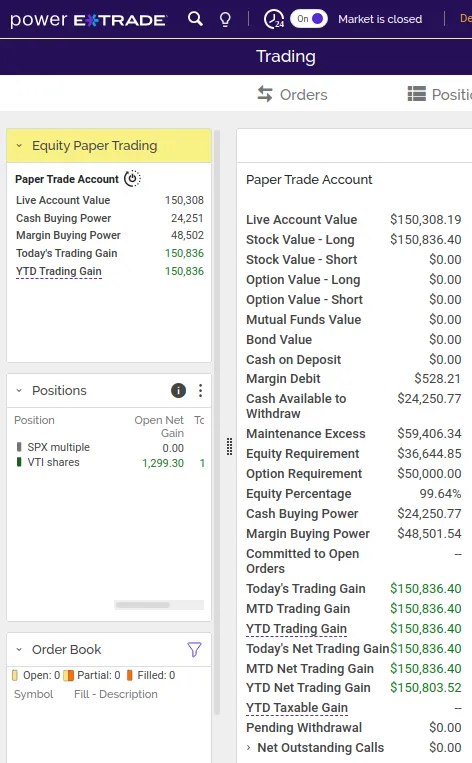
WAT? I hold ~$150k of VTI with no margin loan2 and no box-spreads? I wish. Remember I started with only $100k cash. I'm sure this strategy would be a lot more popular if it could just mint you $50k.
This perturbed me. I reset my account and tried again. The buying power and commission problem fixed itself, but the free-50k-after-box-spread problem persisted, so I tried with another broker.
Thinkorswim (formerly TDAmeritrade, now Schwab)
This was a smoother experience. The box-spread went through. The cash buying power looked correct (still ~100k). I purchased ~150k VTI and saw that I had no margin loan.
After options expiration I could see that I had ~50k of margin loan (well $42k because I under bought VTI this time) and that's exactly what I expected:
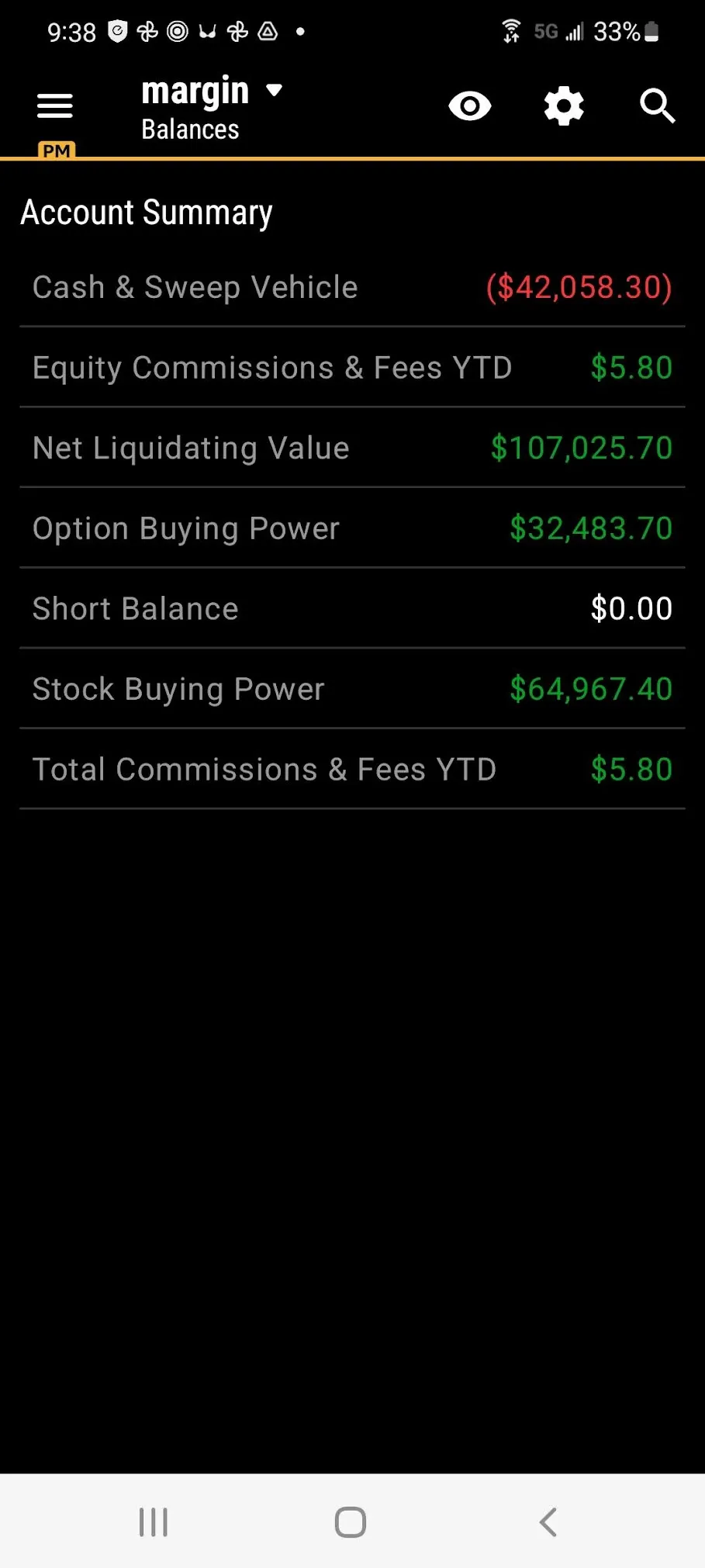
The only commissions/fees were the $5.80 I incurred from selling the box. This was a confidence builder.
VTI also went up a bit in the days it took the options to expire, so I made an extra fake $7k. Which doesn't matter at all, but still makes me feel intelligent and successful.
Interest rate risk
More intuitively, you are locking yourself into an interest rate by buying or selling a box spread. Interest rates may go up or down after you've sold your box. This may be good or bad for you.
Fat finger risk
It's not super complicated, but it is a little complicated and the stakes are high. If you mess up the options trades, and get a little unlucky, you could be out big bucks.
Inheritance risk
Good luck to on whoever needs to untangle this mess for you if you die. Maybe print this post and stick it in your will.
Tax reporting risk
Consider avoiding options that expire too closely the year's end. I've read some antidotes that the different legs of a box can then be reported in different tax years. The risk here is that, due to the size of the options, you'll end up with a huge taxable gain and you wont realize the offsetting losses till the next tax year.
Unknown risk
Like I said earlier, options trading is fraught with land mines. I've covered the ones I know about to the best of my knowledge, but it's possible I've missed something. Do your own research and cross-check everything. I'm not an options expert or any kind of financial professional. I've linked some useful resources below that I've drawn from where you continue your research.
Tax implications
Unlike stocks, which only incur taxes if a taxable event occurs in the given tax year (e.g., you sold the stock), options are taxed yearly by their market value at the end of the year in a process called mark-to-market.
I have never gone though this process, but from what I gather your broker marks the value of your box spread to the current market and reports that number to the IRS. If you are "borrowing" with a box you might expect a small capital loss equal to the interest paid. Conversely, if you are "lending" on a box you might expect a small capital gain.
Furthermore, I suspect the market value of your options changes as interest rates change. For example, if interest rates go up, your short box will be more valuable and you might see a higher market value for your box. Other market conditions likely play a role as well. These factors will have less and less sway as the expiration date approaches.
Anyway, your broker sends you a 1099 with this marked-to-market value listed in Section 1256.

Come tax time, you report this gain or loss on IRS Form 6781.
Since SPX options qualify as a Section 1256 treatment, capital gains/losses are taxed at a 60% (long-term) or 40% (short-term) capital gains rate.
There is a useful post on Bogleheads about a user who paid $5,971 in paper gains on $140,000 of box spread, so that at least gives us a ballpark.
I have one unresolved tax question to which I haven't figured out the answer yet. Namely, is it possible that a bad mark results in an unexpectedly high tax bill? And if so, is there anything that can be done about it?
Section 1258
Section 1258 of the US tax code pertains to investments that are effectively time-value-of-money investments (which is what we have with our LONG boxes). If such an investment is made, any gain from that investment that would ordinarily be taxed at the lower capital gains rate will be re-classifies income and charged a higher tax rate. Does this mean that any gains from a long-box spread will be re-classified as income for tax purposes, eliminating the value of the 40/60 short/long term capital gains tax normally paid on 1256 contracts negating one of the main benefits of the long box strategy?
To me (not a tax professional), based on the tax code and what others have said it seems like no.
This financial planning podcast makes the case that positions that consist exclusively of 1256 contracts (like our options on SPX) are not affected by section 1238. Here is how lawyer Mark Fichtenbaum put it:
This sounds like a problem. Except that Section 1258 has certain requirements that you have to meet in order to fall into that section. So the first requirement is that substantially all of the expected return is attributable to the time value of money, so that's going to affect our transaction. However, there is this second leg that you have to fall into and the first leg is if you buy an asset and enter into a contract to immediately sell that asset that's not us, the second part is this a straddle, an applicable straddle, and I'll come back to that in a second because that defines any straddle as defined in Section 1092 and then three any other transaction which is marketed or sold as producing capital gains. Now if your accountant comes up with this idea and gives it to their client that's not being marketed or sold. Being marketed or sold is being marketed or sold by somebody who is trying to earn a profit by selling you a transaction. The question is our transaction going to be a straddle as defined in section 1092. And normally it would be because when you put together our transaction is going to consist of four options transactions and they are all reducing the risk of the [INAUDIBLE] thats the whole reason we are getting an economic equivalent of interest income; however, if what would otherwise be a straddle consists solely of 1256 contracts than section 1292 does not apply and if section 1092 does not apply then section 1258 wont apply and you wont have conversion transaction. So the key to doing this is to do transactions that consists solely of section 1256 contracts that gives you the economic result that i've been talking about. Thats easily doable in the listed options marked using options from the S&P500 (SPX)
Secondly, there is a BOXX ETF which attempts to replicate the performance of buying 1-3 month box spreads in succession. The prospectus states
Pursuant to section 1256 of the IRC, profit and loss on transactions in certain exchange-traded options, including SPX, are subject to taxation at a rate equal to 60% long-term and 40% short-term capital gain or loss regardless of the Fund’s holding period. Based on the advice of its accountants, the Fund expects that distributions related to the Fund’s SPX positions if any, will be characterized by the Fund as capital gains with these preferential terms.
In conclusion, it looks to me like Box spreads that don't consist of 1256 contracts are subject to re-classification, and box spreads that are are not.
Box Spread Resources
- OCC Box Spreads
- Get Rich Slightly Faster
- Recent Box Spreads to help you price your boxes and corresponding Reddit post
- Options Trade Visualizer (with box spread)
- Options Basics
- Really long Bogleheads thread on box spreads
Conclusion
I'm definitely going to buy my allotment of I bonds. I'm not sure what I will do for the loan. It's either going to be IBKR margin loan or box-spreads, if I have the guts :)
This strategy may make more or less sense as the I bond and loan rates shift over time. Even if I bonds fall out of mathematical favor, it's good to know your loan options in case other opportunities present themselves, e.g., EE bonds or a CD.
Postmortem
I've done it. I used margin (financed by box-spreads) to purchase I Bonds... and some other things. Here's the story.
I decided to open box spreads with expirations about 2 months out, this means that I would get several opportunities to place the orders. The benefits to far out expirations is that you lock in your rate till that time. The benefits of short options is that you maintain flexibility and that the rates for shorter periods are typically lower.
Apr 2022 - Setup a ~200k HELOC but did not withdraw any money, using this as a backup if interest rates become less favorable for borrowing. It cost ~$100 to setup and came with a promotional 2% rate for the first year. At the time box spread rates were lower.
| Date | Action | Borrow Amount | Period Rate | Comments |
|---|---|---|---|---|
| Apr 21th | Open Short Box | $60k | 1.13% | Took out the first short box (borrowing $59,895 repay $60,000 in June. Purchased $50k IBonds ($10k my allocation, $10k wife's allocation, $10k gift from me to wife, $10k gift from wife to me, $10k for trust). The rest of the ~$10k went to VEA @46.66 |
| Jun 17th | Margin Loan | $60k | 3.93% | First box expires, but I have trouble getting my next box to fill, fall back to margin loan (paid $31 of interest on the margin loan over 6 days - 3.93%). |
| Jun 22st | Open Short Box | $100k | 2.13% | Take out my second box (borrowing $99,505 repay $100,000 in Sept - 2.13%) bumped spread up to $100k hoping to get faster fills. Idk if this actually made a difference - it's also slightly better because I pay the same commission/fee no matter what the size of the loan is. The additional $40k went into VEA @40.07. |
| Sep 17 | Margin Loan | $100k | 10.88% | Took a while to get the fill I wanted, had to fall back to hight rate margin loan...ouch |
| Sep 20 | Open Short Box | $100k | 3.47% | |
| Nov 18 | Open Short Box | $100k | 4.69% | No margin loan this time, getting better at it - although at this point, my math says that the HELOC is a more favorable borrowing vehicle than the box spreads, so I plan to switch. It takes a bit though because accounts aren't yet connected cor ACH transfers and I'm trying to decide if I want to take out the whole value of the HELOC or not. |
| Dec 20 | Close Short Box | $100k | 4.69% | |
| Dec 20 | Withdraw HELOC | $200k | 2% | Opened a long box (lending in this case) (lend $97,620 now, receive $100,000 in June - 5.03%) |
2022 year end numbers
I Bonds only
Interest paid: $980.44
Interest earned from IBonds: $1875.00 ($375.00*5);
Pre-tax profit/loss: $894.6
With VEA
Interest paid: $1868.13
Interest earned from IBonds: $1875.00 ($375.00*5);
Capital Gains/Losses VEA: -$1506.43
Dividends from VEA: $1031.65
Pre-tax profit/loss: -$467.91
Tax time. 1099 says that I have $1534 of section 1256 losses (this is just about what I expected) 1099 says that I have $2653 mark-to-market loss from the long box I opened near the end of Dec (This fairly surprising)
I would have expected a small gain in the mark-to-market department instead, it's a long box after all. I get deduct the bonus paper losses on my taxes this year. So lucky me I guess? Maybe this is a better way to reach the income deduction limit each year instead of tax loss harvesting.
Decided to keep riding the HELOC until the 2% introductory rate expired on the 1st of June. HELOC maxed out at $200k. I had ~50k IBonds and ~50k VEA so need somewhere to park an additional $100k for the next 3 months. A long box was perfect!
| Date | Action | Borrow Amount | Period Rate | Comments |
|---|---|---|---|---|
| Dec 18th | Open Long Box | $100k | 5.03% | Took out the first long box. |
50k I Bonds
50k VEA
100K Long Box @ 5.03%
As of June 15th 2023, I no longer have any active boxes LONG or SHORT. I'm neither borrowing or lending any money in this way.
So where does that leave me:
April 2022 to Jun 15th 2023 - Final numbers
Total Interest paid: $3284
Total Interest earned from I Bonds: $3840
Total Dividends from VEA: $1031
Total Capital gains VEA: $7573
Total Pre-tax profit: $9160
Pretty sweet! The majority ($7573) of this gain was due to fortunate market timing. VEA (as of November 2023) has come down quite a bit from it's June 15th highs but I'm confident I'm still quite positive without the VEA risk included.
I plan to sell my I bonds in December 2023 once the interest rate drops to 3.XX for 3 straight months (which I will forfeit the interest for since I am selling within one year).
Things I learned about HELOCs
Post TCJA, HELOCs can NOT be deducted unless the funds are used to improve your primary residence.
However, the IRS says that “you can choose to treat any debt secured by your qualified home as not secured by the home.” Which means you can deduct the interest if you used the money from the loan to purchase taxable investments). https://illuminationwealth.com/make-heloc-tax-deductible/
Even though I bonds are not taxable at the state level they are taxable at the federal level, so I believe they qualify as taxable investments for this purpose.
Practical takeaways:
- Setting up and account w/ margin and the correct options level was somewhat annoying and took a month.
- Getting the fills you want isn't the easiest.
- Short boxes give you access to really good borrowing rates for a secured loan. I don't know of anything better.
- Long boxes give you a pretty good rate of return (I don't see why I would ever buy a CD again - long boxes seem to give better rates AND have much more favorable tax treatment).
Overall, this has been an interesting and rewarding project. I learned a ton, I made some $, and have two new financial tools that I feel comfortable deploying in the future both borrowing my and fixed income needs!
Also See
Long Term Returns: 4%? 7%? 14%? 6.17%?: Analysis of S&P500 returns from 1871 to 2021
Postmortem
I've done it. I used margin (financed by box-spreads) to purchase I Bonds... and some other things. Here's the story.
I decided to open box spreads with expirations about 2 months out, this means that I would get several opportunities to place the orders.
The benefits to far out expirations is that you lock in your rate till that time. The benefits of short options is that you maintain flexibility and that hey rates for shorter periods are typically lower.
Apr 2022 - Setup a ~200k HELOC but did not withdraw any money, using this as a backup if interest rates become less favorable for borrowing. It cost ~100% to setup and come with a promotional 2% rate for the first year. At the time box spread rates were lower.
| Date | Action | Borrow Amount | Period Rate | Comments |
|---|---|---|---|---|
| Apr 21th | Open Short Box | $60k | 1.13% | Took out the first short box (borrowing $59,895 repay $60,000 in June. Purchased $50k IBonds ($10k my allocation, $10k wife's allocation, $10k gift from me to wife, $10k gift from wife to me, $10k for trust). The rest of the ~$10k went to VEA @46.66 (we're a little short on international) |
| Jun 17th | Margin Loan | $60k | 3.93% | First box expires, but I have trouble getting my next box to fill, fall back to margin loan (paid $31 of interest on the margin loan - 3.93%). |
| Jul 31st | Open Short Box | $100k | 2.13% | Take out my second box (borrowing $99,505 repay $100,000 in Sept - 2.13%) bumped spread up to $100k hoping to get faster fills. Idk if this actually made a difference - it's also slightly better because I pay the same commission/fee no matter what the size of the loan is. The additional $40k went into VEA @40.07. |
| Sep 17 | Margin Loan | $100k | 10.88% | Ouch |
| Sep 20 | Open Short Box | $100k | 3.47% | |
| Nov 18 | Open Short Box | $100k | 4.69% | No margin loan this time, getting better at it - although at this point, my math says that the HELOC is a more favorable borrowing vehicle than the box spreads, so I plan to switch. It takes a bit though because accounts aren't connected and I'm trying to decide if I want to take out the whole value of the HELOC or not. |
| Dec 20 | Close Short Box | $100k | 4.69% | |
| Dec 20 | Withdraw HELOC | $200k | 2% | Opened a long box (lending in this case) (lend $97,620 now, receive $100,000 in June - 5.03%) |
Tax time. 1099 says that I have $2000 of section 1256 losses (this is just about what I expected) 1099 says that I have $3000 mark-to-market loss from the long box I opened near the end of Dec (This fairly surprising)
I would have expect a small gain in the mark-to-market department instead, it's a long box after all. So lucky me?
Taxes are fairly complex.
Things I learned about box spreads along the way.
- Don't let them expire too close to the year end, this can apparently result in some legs registering gains/losses on one year and other legs in the next.
- There does seem to be some small counter party risk (in case of OCC failure)
- The IRS defines Straddles are a thing. This can result in disallowed loss deductions if . By my reading this can be avoided by properly identifying straddles aren't property identified in your records (and they aren't part of a larger straddle).
- For long boxes, capital gains (60/40 in this case) might be re-characterized as regular income according to section 1258 (https://www.law.cornell.edu/uscode/text/26/1258) if "substantially all of the taxpayer’s expected return from which is attributable to the time value of the taxpayer’s net investment in such transaction"
More discussion: https://www.bogleheads.org/forum/viewtopic.php?t=371120&start=450"
Things I learned about HELOCs
- Post TCJA, they can't be deducted unless they are used for primary home improvement
- However you can re-classify them as non-secured-by-residence, which makes them subject to interest tracing rules (which means you can deduct them if you used the money to purchase investments)
- But not investments that aren't taxable.
- but, I believe, I bonds are considered taxable (even though you don't owe state tax on them)
Disclaimer
I, the author of this post, have no formal tax, accounting, or financial background. I've done my best to ensure the information is accurate, but it's possible that I've missed important information, miscalculated something, or made some other errors/omissions. If you see something that's incorrect, please contact me. As always, the site disclaimer applies.
Footnotes
-
Some types of options can be exercised early. See Assignment risk for details. ↩
-
Yes, I technically have a $528.21 margin loan but only because I slightly over-bought VTI and this value didn't update after the options expired this should be ~50k. ↩